Fred Davis, CEO of Strategic Perception, Inc., a political consulting firm spoke with me, David Spark, after his fantastic presentation at The CMO Club Peer to Peer Summit in San Francisco. I asked him given the legacy of George Bush, and the economy, how he dealt with creating advertising to strengthen John McCain's campaign.
Check out all coverage at The CMO Club Peer to Peer Summit.
Showing posts with label CMO events. Show all posts
Showing posts with label CMO events. Show all posts
Friday, November 7, 2008


Marketing John McCain plus Election Results Implications for CMOs
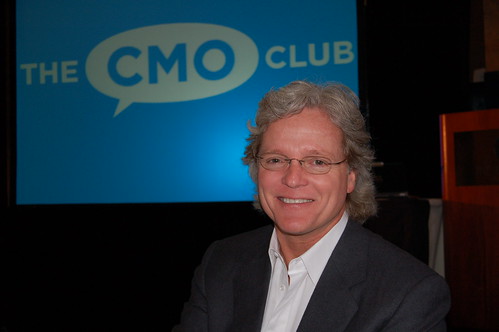 Fred Davis, CEO of Strategic Perception, Inc., a political consulting firm, offered some timely political discussion with his presentation, "Marketing John McCain plus Election Results Implications for CMOs."
Davis has created many political ad campaigns before John McCain. He created George W. Bush's four years ago, Sarah Palin's governor race in Alaska, and many many others.
Davis' first client, Jim InHofe in Georgia, was a candidate that was 30 points down in the polls when he first took him on. The agreement he made with that first client, who had no money, is that he would do the campaign for nothing, but his client couldn't have any input on the creative. While there were moments of near heart attacks (the first ad had men in pink tutu's in prison dancing with each other), in the end, his candidate won by 15 points, a 45 point swing.
Davis attributes his success in political advertising to taking advantage of traditional ad marketing techniques. He created signature humorous political ad campaigns (often negative) and purposely avoided those negative "He lied" campaigns.
There are some major differences about Davis' political ad business versus when he was working in traditional advertising. Those difference are:
- He gets his money upfront.
- He's always out of work on November 5th and he knows immediately if his client is successful or unsuccessful.
- He has major issues with the press.
- He usually gets the final say.
Davis went into the John McCain campaign with 95% of the country thinking they were on the wrong track. Given that McCain was a Republican, he was tied to the George W. Bush presidency. As a result, Davis realized McCain's campaign had to be about character and not about issues.
Davis has made many controversial ad campaigns, most notably the negative celebrity ad that included Paris Hilton. He showed two very funny ads that attacked Obama's lack of accomplishments and were supposed to run during the DNC, but unfortunately never ran because the woman in the ad died the day before they were supposed to run.
McCain simply couldn't raise as much money as Obama. He did George W. Bush's campaign for $180 million which was plenty of money. This year John McCain had $200 million, which was a nice increase. But Obama's team raised $700 million and were very targeted on spending. For example, in just New Hampshire, the McCain team was outspent by Obama's 10 to 1.
In an effort to save money, Davis was strongarmed into doing a series of hybrid ads which meant he had to split a 30 second ad which really ended up being 12.5 seconds to get their message out. You need the last five seconds for the candidate to say, "I'm John McCain and I approve this message."
Davis believes what really happened that caused the demise of McCain was the country's financial collapse. Most of America started thinking, "Maybe I do need the government to save me." Barack Obama embodied that the government could save you.
Check out all coverage at The CMO Club Peer to Peer Summit.
CMO Club SF party video
During the mixer on the first night of The CMO Club Peer to Peer Summit in San Francisco, I took out my Nokia N82 and streamed some video of the party. I interviewed many people as to what they got out of the first day of the conference. Enjoy. The video is about 20 minutes.
Check out all coverage at The CMO Club Peer to Peer Summit.
Check out all coverage at The CMO Club Peer to Peer Summit.
AdMob runs a successful 24-hour mobile ad test with Symantec
AdMob, the mobile ad company, ran a successful 24-hour only mobile ad campaign with Symantec. Tony Nethercutt of AdMob talked to me about how they wanted to score as many clickthroughs in 24 hours (they got 3000 at $.50 a click).
Check out all coverage at The CMO Club Peer to Peer Summit.
Check out all coverage at The CMO Club Peer to Peer Summit.
Aprimo partners with Kodak on brand content management
At the last CMO Club conference I spoke with Aprimo about their enterprise marketing services. At the conference in SF, I asked CMO Bob Boehnlein what's changed over the past few months at Aprimo and it was all about their partnership with Kodak and how to bring an idea to fruition faster.
Check out all coverage at The CMO Club Peer to Peer Summit.
Check out all coverage at The CMO Club Peer to Peer Summit.
Improving the landing page experience for visitors
I spoke with Jason Smith and Seth Rosenblatt of Interwoven about what have been the biggest improvements and changes at Interwoven. I had interviewed Interwoven at the last CMO Club conference in NYC. I needled them a little, but we got to the answer I wanted eventually. Watch the video until the end. :)
Check out all coverage at The CMO Club Peer to Peer Summit.
Check out all coverage at The CMO Club Peer to Peer Summit.
SEM: Understand the entire experience of your visitor
I spoke with Bill Muller, CMO of iProspect about what are the most common mistakes people make with SEM, and he said, not fully understanding the entire experience of a visitor for the lifetime they touch your brand and site.
Check out all coverage at The CMO Club Peer to Peer Summit.
Check out all coverage at The CMO Club Peer to Peer Summit.
Develop revenue from your social media efforts
I spoke with Jason Breed of Neighborhood America about how he gears companies to develop actual revenue from their social media efforts.
Check out all coverage at The CMO Club Peer to Peer Summit.
Check out all coverage at The CMO Club Peer to Peer Summit.
Close sales cycles faster with ZoomInfo
I had spoken to Erica Ewing of ZoomInfo at the last CMO Club conference in NYC. As a follow up I asked Ryan Stanton about what's changed with ZoomInfo over the past 6 months.
Check out all coverage at The CMO Club Peer to Peer Summit.
Check out all coverage at The CMO Club Peer to Peer Summit.
Tom Wieser of CGS on VirtualEvents365
I spoke with Tom Wieser, CMO of CGS and VirtualEvents365 about how his virtual events work and why it's better in some cases than having a live event.
Check out all coverage at The CMO Club Peer to Peer Summit.
Check out all coverage at The CMO Club Peer to Peer Summit.
Thursday, November 6, 2008
Faith of Oodle and Leslie of ZipRealty on deploying social media
I spoke with Faith Sedlin of Oodle and Leslie Tyler of ZipRealty on what they learned from The CMO Club Peer to Peer Summit so far, and their favorite was the round table discussion on social media for their business.
Check out all coverage at The CMO Club Peer to Peer Summit.
Check out all coverage at The CMO Club Peer to Peer Summit.
Drew Neisser of Renegade on what CMOs are doing in social media
I spoke with Drew Neisser, President of Renegade about what he learned from other CMOs during the round table discussion on social media he moderated.
Check out all coverage at The CMO Club Peer to Peer Summit.
Check out all coverage at The CMO Club Peer to Peer Summit.
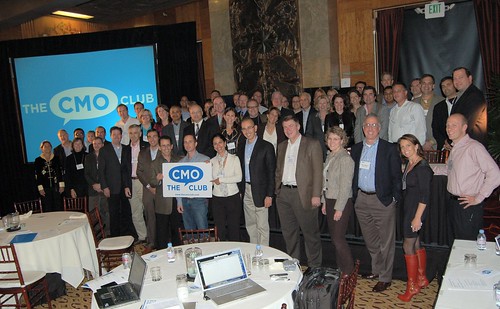
Summary of all coverage at The CMO Club Peer to Peer Summit
David Spark here from Spark Media Solutions. I've been covering The CMO Club Peer to Peer Summit in San Francisco from November 6-7, 2008.
Here's a summary of all the coverage from the summit.
Posts
Here's a summary of all the coverage from the summit.
Posts
- Marketing John McCain plus Election Results Implications for CMOs
- Challenges for CMOs - Here's a list
- What's the formula for a successful CMO?
- CMO roundtable discussion on social media
- Insights on ROI from CMOs
- Meaningful Measurements and Monitoring for Real Success
- How Social Media, Corporate Social Responsibility, and Cause Marketing Work Together
- Pushing The Envelope on New Approaches/Ideas for Online Marketing
- Photos from The CMO Club Peer to Peer Summit
- Driving In-Market Success by Leading Organization Alignment
- Being a Better CMO
- CMO is a Credibility War Every Day
- The guy who created all of McCain's ads explains what happened
- CMO Club SF party video
- AdMob runs a successful 24-hour mobile ad test with Symantec
- Aprimo partners with Kodak on brand content management
- Improving the landing page experience for visitors
- SEM: Understand the entire experience of your visitor
- Develop revenue from your social media efforts
- Close sales cycles faster with ZoomInfo
- Tom Wieser of CGS on VirtualEvents365
- Drew Neisser of Renegade on what CMOs are doing in social media
- Evan Scott of Shumsky on Benchmarking
- Faith of Oodle and Leslie of ZipRealty on deploying social media
Evan Scott of Shumsky on Benchmarking
Evan Scott, CMO of Shumsky discussed what he learned about the importance of benchmarking when you're setting up the ROI for your business. Scott references Heidi Melin's presentation, "Meaningful Measurements and Monitoring for Real Success."
Check out all coverage at The CMO Club Peer to Peer Summit.
Check out all coverage at The CMO Club Peer to Peer Summit.
Monday, November 3, 2008
CMO is a Credibility War Every Day
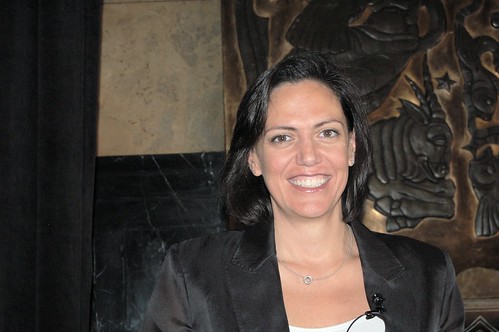 Patty Azzarello, CEO of Azzarello Group, continued the discussion about managing the CMO role with her presentation, "CMO is a Credibility War Every Day." She walked the audience through some great advice for the CMOs on how to build their credibility within the organization.
Building credibility is a task for any executive, not just CMOs
- Credibility is inversely proportional to stupid questions (e.g. Why are you spending money on that? Do you think that's important?) The higher the credibility the fewer you get these stupid questions.
- People with high credibility get more done.
The CMO has extra credibility challenges built right into the role. You're not always seen as a business leader, the system is pitted against you, your budget is easy to cut, brand is built by their behavior, yet bad perception is the fault of marketing. Plus, if the CMO doesn't have product marketing reporting to him/her, then you've got a major strategy and positioning disconnect.
Lastly, does the CEO "get it." If not, you still may have opportunities if you've got a good corporate situation.
Building credibility
- Do things on purpose
- Schedule and make time for issues - Make room to do extra stuff. No one is going to do it for you. They don't have motivation to do it. The most successful people are not burned out. They don't have to do everything. Focus on your "ruthless priorities."
- Build capacity in your team - Get better results out of the same programs over time and take costs out year after year. Don't keep asking for money year after year. Do better with less. In addition, increase the capabilities and learning agenda (individual and team level) of your team.
- Act like a general manager (how you position the way you spend money, build an internal communications plan for your stakeholders)
- Make sure your marketing plan is not isolated to marketing.
- Show your understanding of the P&L and what impact your spending has on profit.
- Get your priorities ratified by the business.
- Tie your marketing approach to business model objectives.
Azzarello recommends what she calls a "left column makeover." And what that involves is taking your costs and divide them up in newly titled categories that have high level marketing and business goals. Put those headings over the costs so they know what that is. An example of those three columns could be:
- Support current business/products
- New initiatives and improvements
- Strategic initiatives.
Key Internal Stakeholders - The CEO
All they think about are trade offs. Get your head in the trade off mode. Marketing makes them nervous. Understand the issues they have which is primarily profit and share value. They also want to be industry changing and want to be seen on the map in a different way.
The CFO
Win the CFO over and try to have them see you more as a person than just dollars which is all they traditionally think about.
Sales
Show up and meet the sales staff. Advertise a process to the sales force as to how they should communicate with marketing. You bring it back to sales and ask them to create the top ten list of issues. Attend reviews (in person or on phone at any time). Make sure you have ex-salespeople on your team.
Ask the salespeople what happened to your leads
Don't tolerate endless requests for more leads if they can't account for the ones they already have.
Measurement
Are you measuring to increase effectiveness, or are you doing it just to keep people off your back? Be prepared, because you'll be attacked.
Check out all coverage at The CMO Club Peer to Peer Summit.
Driving In-Market Success by Leading Organization Alignment
 Amy Roman and David Covucci, Principals of CMO Associates, led a discussion entitled, "Driving In-Market Success by Leading Organization Alignment."
They shared results from a CMO survey where they're in the process of trying to uncover what separates super star CMOs from really good CMOs.
They boiled down the number one challenge for the CMO role is getting the organization aligned. Here are the main barriers a CMO has to deal with:
- Who is responsible for value delivery?
- Who are the required 'value team' members?
- How do we communicate with each other?
- What is our process?
- Over 90% stated organizational alignment is very important to marketing success and customer retention.
- Over 60% stated their company performs inconsistently or very poorly in achieving organization alignment.
- Over 85% stated the CEO was responsible for alignment leadership, or there was no designated leadership.
- CMO has best vantage point to understand all of the key details and can foster collaborative rather than authoritarian alignment process.
- Establish an alignment process. You get consistency. CMOs provide the energy and facilitation.
- Construct a process that facilitates collaboration, coordination, communication, and giving credit.
- Develop a systematic approach to implement this process.
- Enlist 'C' level peers and sell the CEO on the revised CMO role.
- Give the organization a common language.
- Make alignment imperatives visible to everyone.
- Enlist support of peers through collaboration.
- Show the CEO that you have a plan and the support of your peers.
Step 1 - Own the value proposition. This is what CMOs already do and know they should do.
Step 2 - Define the value delivery network. Know the roles, functions, and processes involved in the value delivery (e.g. pricing, value, sales, delivery, and measurement).
Step 3 - Construct the network alignment model. This is the core and defines what alignment actually looks like. How should roles and processes be integrated with each other to deliver value to the customer base? Customers should be a part of this process and it's the primary communications process for the rest of the organization. And it's what you should be showing to your CEO to explain what alignment looks like at your organization. To actually align it you start with situational success and you move towards continous improve it.
Step 4 - Structure the leadership role.
The skills and competencies you need to make it work require you to think beyond the traditional four P's and think of alignment as a team effort for both marketing and non-marketing staff. Ultimately, this alignment will be highly customized and be malleable to deal with different situations.
CMOs surveyed by CMO Associates were asked what are the three most important factors for successful alignment. Here were the most often cited factors:
- Clearly articulated value proposition
- Clear understanding of what alignment looks like
- Alignment between sales and marketing
- Metrics for non-marketing functions
- A scorecard to measure and monitor alignment progress
- Appropriate executive owns the value proposition
Pushing The Envelope on New Approaches/Ideas for Online Marketing
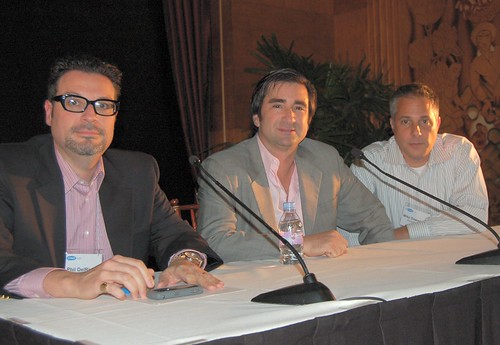 Looking for a new idea and approach to online marketing? Then you wanted to be in the room for the discussion, "Pushing The Envelope on New Approaches/Ideas for Online Marketing." Greg Estes, CMO of Mozes led the panel discussion. On the panel (from left to right) were:
- Phil DelRivo, CMO of Total Beauty Media
- Stuart Halperin, CEO of Ultimate Movie Site
- Mike Doernberg, CEO of ReverbNation
- Doernberg - You need to leave things behind for success. Connect advertising to a certain objective. Your program shouldn't just be about reach. If traditional ad buys aren't achieving your objective, then dump it. Stop taking an old approach to a new model.
- DelRivo - Anything we can send out to women that has a list of the "worst" products, that gets the highest open rates.
- DelRivo - These bloggers may not have the reach of traditional advertising, over time their influence is huge. And individuals may not be that impactful, but en masse they're very powerful.
- DelRivo - Avoid the stupid online games that have nothing to do with the engagement you're trying to create or the product you're trying to sell.
- Halperin - Virtual points is a way of giving something to your users and creating an engagement and keeping them more involved in the process. Give them a chance to let their status rise in your environment.
- Doernberg - As a brand you have to be genuine. His son loves the MyCokeRewards. He demands his dad buys Coke products so he can cash in on the rewards. People are jaded, but if you give them something real, they get behind it. If you give them something fake, they'll ignore it.
- Halperin - Compensation doesn't always mean money. It can also be a forum or let them have their opinion heard in a very profound way. Can increase status and priveledges.
- Doernberg - How do you get reach and credibility without having armies of people doing the work? Technology allows this to happen.
How Social Media, Corporate Social Responsibility, and Cause Marketing Work Together
 Lee Fox, CEO of KooDooZ led a presentation entitled, "How Social Media, Corporate Social Responsibility, and Cause Marketing Work Together."
Benefits of CSR (Corporate Social Responsibility):
- Cost effective way for an organization to improve competitive position
- Protecting the environment leads to more productive use of resources
- Boosting social conditions, including education, leads to improved locations for company operations and potential creation of customers and skilled workers
- Investors are drawn to socially responsible companies
Don't just look like you're a socially responsible company. Actually, be involved. For example, don't just launch a product that's pink during Breast Cancer Awareness month and then do nothing else. If you do, then that fake CSR is going to get out in the social networks.
Don't take the corporate defensive attitude when your lack of CSR is exposed
Artist used a Louis Vuitton purse in an anti-genocide campaign to make the point that the media cares more for celebrities than they do for geneocide in Darfur. They complained the person who did this was abusing their brand and they sued. The result is that the public thought that Louis Vuitton didn't care about the Darfur genocide.
Fox whipped through many examples of CSR. One issue she mentioned is if your product is being talked about, it's worth knowing why. Like the brand jacking situation of Louis Vuitton.
- SIGGART design contest allowed people to modify their brand. As a result, they got 17 minutes average time on site.
- Avanta's ideablob is a place where people can share their ideas in a community setting. This is a stretch on CSR because much of it was supporting local businesses. But in some cases CSR can be seen this way. They did get nonprofit organizations to participate (15%) and 66% of the 100,000 users are socially conscious.
- Set goals
- Focus
- Build internal capacity
- Create a team
- Find ambassadors of the cause
- Choose partners carefully
- Leverage all assets
- Add sizzle
- Communicate and innovate
- Go local
Check out all coverage at The CMO Club Peer to Peer Summit.
Marketing in an Economic Downturn: What it Means and Insights for You as CMO
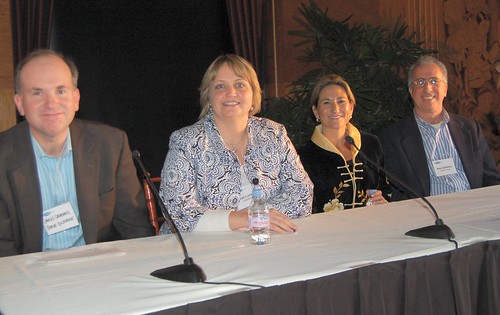 Trying to understand and cope with the economic times we're in, three CMOs joined together for a discussion entitled, "Marketing in an Economic Downturn: What it Means and Insights for You as CMO." On the panel (in order in photo) were:
- Jarvis Cromwell, CMO of Storm Exchange
- Heidi Lorenzen, VP of Interwoven
- Hope Frank, CMO of ZIP and TRG Capital
- Alan Gellman, SVP of Wells Fargo
- Cromwell - Put things in the transaction settings and think about how you can drive more trust.
- Cromwell - Three issues to consider. Think about innovation. Each client intends to be in business and they need help. Listen and understand what they want to hear. Inspiration: be a leader and realize nobody should be able to do this better than you. Lastly is have good intentions for your employees and your clients.
- Gellman - In this economic environment there's a flight to quality. People are scared.
- Lorenzen - Companies panic during tough economic times. They'll take a centralized approach. And it's good to save money, but you lose connection with customers when you centralize. You must stay close to your customers which is a field model and that allows for agility. Have a corporate organization where you can stay aligned with your field.
- Frank - I like to turn the CEO and product into superstars. People get scared when I'm hired. I'm sorry for that, but I'm hired by the shareholder and the company.
- Lorenzen - If you can't sell it inside, you can't sell it outside.
- Cromwell - The average company has done an abysmal job on employee engagement. And yes, it matters.
- Cromwell - While you need to get rid of the under performers, you also have to get rid of the great performers that are poisoning your environment.
- Frank - I like to build a new team, no matter where they are in the world.
- Gellman - Let your employees know that you know what they're doing. Gellman asked the audience of CMOs how many can list of their top three priorities and also know the top three priorities their direct reports. Only one hand in the room was raised.
- Frank - Currency is everything. Not just finances, but the value of your brand. In one case, Frank launched her brand Vivitar only in Dubai because the margins were so good. She didn't bother in the U.S. because the margins were so poor there.
- You need to change and sometimes things don't work into your five year strategic plan.
- Gellman - Most people don't want to change, but they can.
Subscribe to:
Posts (Atom)



 Posts
Posts