This past week I asked CMOs in the club to respond to this question. Here are the results:
1) Over 32% responded with “Building Credibility with my CEO”.
2) Almost 29% said “Career Coaching”.In thinking about this response I suggest a large part of career coaching is linked to building credibility with your CEO. Patty Azzarello spoke at our Summit last November in SF and her session was one of the highest rating sessions by CMOs in attendance. I am also pleased to note that Patty will be working with The CMO CLUB, starting in early April, as one of the CMO coaches in our upcoming “Members Only” Coaches Coach’s Section on the site”. She will be hosting a forum, weekly blog posts and monthly CMO call for CMOs interested in this topic. More to follow.
3) 21.4% noted “ROI/Financial Management”
With the shift to measureable results oriented marketing this is not a surprise. We actually had a great discussion at one of our Boston dinners with the help of Marketing NPV and actually dissected ROI and budgeting techniques for prioritizing limited marketing dollars. I would also suggest that personal coaching on ROI and Financial Management will build credibility with your CEO.
4) 10.7% responded with “Talent Development” as most valuable to them.
I asked a few CMOs their view on this response and they had some interesting comments. One CMO noted, “It is clearly a top priority for me but right now my lifeline to success is my CEO so I need to stay on top of this and do everything I can to build credibility with him”. Another CMO noted that if the question was rephrased to “Most valuable over next 2-3 years”, she would have Talent Development as her answer.
5) 7.1% selected Contract Negotiation as most valuable to them.
During more aggressive growth times I think this area would be of higher value.
In summary we care about building credibility with our CEOs. How much time per week are you spending thinking about this and do you have an actual plan in place to achieve?
Showing posts with label roi. Show all posts
Showing posts with label roi. Show all posts
Saturday, March 7, 2009


Thursday, November 6, 2008
Evan Scott of Shumsky on Benchmarking
Evan Scott, CMO of Shumsky discussed what he learned about the importance of benchmarking when you're setting up the ROI for your business. Scott references Heidi Melin's presentation, "Meaningful Measurements and Monitoring for Real Success."
Check out all coverage at The CMO Club Peer to Peer Summit.
Check out all coverage at The CMO Club Peer to Peer Summit.
Monday, November 3, 2008
Insights on ROI from CMOs
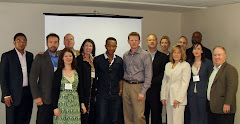
 Following the keynote discussion from Heidi Melin, CMO of Polycom about calculating success, three CMOs joined in a discussion about ROI (from left to right in picture).
- Dave Scott, CEO of Marketfish
- David Cumberbatch, CMO of SimpleTuition
- Greg Estes, VP of Mozes
- Cumberbatch - Focus on conversion of the visitor through different processes. Whether online or online to offline. Revenue per visit is the number one factor that he's able to see.
- Cumberbatch - Lifetime value of a customer is key, both short term and long term by channel which has different latency characteristics. How often a customer comes back from an email or a search engine varies greatly. In some cases it's easy to calculate lifetime value if he makes a sale directly with a customer. When it's not easy is when there is no monetary sale. In those cases, he has to use some fuzzy math and must attach some value to an event (e.g. signing up for a social network) even if it doesn't generate immediate revenue.
- Scott - On the B2B side, the problem is you have thousands of points of failure. Every time you add a human interaction you can pollute the numbers and diagnostics.
- Scott - When you ask a salesperson how you got the deal, they'll always tell you it's because of their amazing skill. They'll never say it's a factor of the quality of the lead. But if they lose a deal, the salesperson will complain that it was a crappy lead.
- Scott - If someone downloads a whitepaper, they're a lead. But when they download their second and third whitepaper, they're a hot lead. You need to track that and push that information to the sales force.
- Estes - It's not about an individual activity that closes a sale, but rather the collection of activities that allows it to work. He doesn't believe the customer even knows. Think about it yourself. Do you know why you actually purchased a specific dishwasher?
- Estes - Follow your marketing instincts to segment your audience. What is important to all your C-level peers?
- Estes - Ask yourself and others, "What is the number one unexploited opportunity for the company?"
- Scott - Understanding what stage of the buying cycle the customer is in is extraordinarily important. As a plug for my business (Spark Media Solutions), I have a great whitepaper that goes into this issue in great detail offering suggestions about how to build that industry voice at every point along the buying cycle. It's entitled "Be the VoiceSM" - Build Your Business by Becoming your Industry's Thought Leader.
- Cumberbatch - How do you defend brand equity spend when you're getting pressure to cut it because it seems that it's fluffy and not critical. You need to have the conversation upfront, rather than at the end when budgets are tightening. In addition, Cumberbatch argues that it can sometimes be a case of you're spending in an area where your competitor isn't and this is a great opportunity to be seen.
- Scott - Did a study on his brand and saw that his old company was #2 in the space. When they went after business, their number one competitor was in the running 90% of the time. Yet when his number one competitor would go after a business his company was only a consideration 40% of the time. That means companies didn't even know they existed 60% of the time and they were losing out on opportunities. They NEEDED to raise their awareness.
Meaningful Measurements and Monitoring for Real Success
 Heidi Melin, CMO of Polycom, opened The CMO Club Peer to Peer Summit with her keynote session, "Meaningful Measurements and Monitoring for Real Success."
According to Marketing Sherpa, 60% of large companies have already made marketing cuts or are expecting cuts. But we're better prepared in today's recession than we were back in the recession of 2001.
The reason for our increased preparedness, said Melin, is an improved focused on monitoring and measurement. Melin began by isolating long and short term measurements.
Long term measurements:
Benchmarking
Key tool to protect budgets, justify spending, and set goals. Turn to benchmarks when you don't know what you should spend. Melin pointed to IDC's benchmark on a variety of variables. (NOTE: IDC figures in parenthesis.)
- Marketing budget as a percentage of revenue (6.5-7.5%)
- Insource vs. Outsource (39% People inside/61% programs outside)
- Awareness vs. Demand/Content (49% Awareness)
- Program dollars by sales headcount ($42,788/Sales HC - this is for $1B is sales or more. For companies that are $.5B to $1B it's $52,581/Sales HC)
Customer attitudes
Almost all of the CMOs in the room are using NetPromoter or formal customer satisfaction measurements. Allows you to understand the customer and what they're thinking, but also a customer measurement tool's value is allowing you to think strategically.
Polycom, like many organizations, has been shifting its processes from being product-centric to customer-centric. This required shifting a group of engineers to stop thinking about building things just because it's cool. At Polycom, they're hearing the customer voice through advisory councils (influential customers that are providing input into the engineering and executive team), formal customer research, and spending time with customers and understanding why they're happy.
It's not about putting the customer first. Melin believes it's about putting the customer in the center of your decision making process.
Polycom uses real time NPS (NetPromoter) snapshot/dashboard from Zuberance so that they can respond to events. This tool is available online for all their executives. Overall feedback of company and also specific product. They have found that product experience
Top NPS performers beat 75%. Polycom's score started out as 25%. The NetPromoter score is calculated from a combination of your promoters and detractors. A high score (Apple) means you have way more promoters than detractors.
Short term measurements:
Lead management metrics
Demand generation funnel: This is a funnel about sales and marketing. Understanding your lead funnel is critical as is being able to measure those leads all the way to close.
Marketing automation: Investment in process improvement often doesn't require significant budget but can be significant in return. If you don't have a way to measure ROI, now is the time to invest.
Summary
Economic uncertainty offers an opportunity for the continued rise of the CMO. You can spend wisely and deliver measurable results. Drive customer insight into the business. Focus on process improvements to drive more return.
Next to doing the right thing, the most important thing is to let people know you are doing the right thing.
Check out all coverage at The CMO Club Peer to Peer Summit.
Subscribe to:
Posts (Atom)



 Posts
Posts