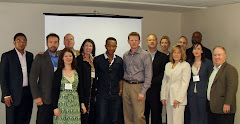
A lively group of CMOs meet last night in Chicago with a number of insightful discussions including:
1) The shift of customers/consumers from "Quality" to "Value" and the implications for CMOs in both B2C and B2B. The group discussed the recent Dunkin Donuts and McDonalds approach to going after Starbucks leveraging the better "value for money" messaging.
2) Great B2B discussion around changes in Product Management and Product Marketing (there is a difference) and the need for ensuring Customer Centric approaches to these critical areas within our organizations.
3) New approaches to company lead Events to ensure customer retention.
4) Bill Kies provided excellent deep dive into changes in the Grocery industry for retailers and CPG companies selling through Grocery. The growth in data driven predictive modeling giving the upper hand back to the retailer was also covered.
5) The group came up with a few good ideas for forum question within the club on "The top 30 questions to ask your first 30 days as a new CMO". More to follow.
6) Jeff Caswell new with Quaker Foods shared his efforts in leading 'Project 100" in which 100 leaders in the industry weighed in on Social Marketing. The result will be a book with all proceeds going to charity (watch video for more details). A number of CMOs in the club participated.
Finally, David Cumberbatch had his first day with new company and joined the dinner last night to start networking with other CMOs in Chicago.A great evening and our best CMO CLUB dinner to date in Chicago. More to follow.
Showing posts with label David Cumberbatch. Show all posts
Showing posts with label David Cumberbatch. Show all posts
Wednesday, January 28, 2009


Monday, November 3, 2008
Insights on ROI from CMOs
 Following the keynote discussion from Heidi Melin, CMO of Polycom about calculating success, three CMOs joined in a discussion about ROI (from left to right in picture).
- Dave Scott, CEO of Marketfish
- David Cumberbatch, CMO of SimpleTuition
- Greg Estes, VP of Mozes
- Cumberbatch - Focus on conversion of the visitor through different processes. Whether online or online to offline. Revenue per visit is the number one factor that he's able to see.
- Cumberbatch - Lifetime value of a customer is key, both short term and long term by channel which has different latency characteristics. How often a customer comes back from an email or a search engine varies greatly. In some cases it's easy to calculate lifetime value if he makes a sale directly with a customer. When it's not easy is when there is no monetary sale. In those cases, he has to use some fuzzy math and must attach some value to an event (e.g. signing up for a social network) even if it doesn't generate immediate revenue.
- Scott - On the B2B side, the problem is you have thousands of points of failure. Every time you add a human interaction you can pollute the numbers and diagnostics.
- Scott - When you ask a salesperson how you got the deal, they'll always tell you it's because of their amazing skill. They'll never say it's a factor of the quality of the lead. But if they lose a deal, the salesperson will complain that it was a crappy lead.
- Scott - If someone downloads a whitepaper, they're a lead. But when they download their second and third whitepaper, they're a hot lead. You need to track that and push that information to the sales force.
- Estes - It's not about an individual activity that closes a sale, but rather the collection of activities that allows it to work. He doesn't believe the customer even knows. Think about it yourself. Do you know why you actually purchased a specific dishwasher?
- Estes - Follow your marketing instincts to segment your audience. What is important to all your C-level peers?
- Estes - Ask yourself and others, "What is the number one unexploited opportunity for the company?"
- Scott - Understanding what stage of the buying cycle the customer is in is extraordinarily important. As a plug for my business (Spark Media Solutions), I have a great whitepaper that goes into this issue in great detail offering suggestions about how to build that industry voice at every point along the buying cycle. It's entitled "Be the VoiceSM" - Build Your Business by Becoming your Industry's Thought Leader.
- Cumberbatch - How do you defend brand equity spend when you're getting pressure to cut it because it seems that it's fluffy and not critical. You need to have the conversation upfront, rather than at the end when budgets are tightening. In addition, Cumberbatch argues that it can sometimes be a case of you're spending in an area where your competitor isn't and this is a great opportunity to be seen.
- Scott - Did a study on his brand and saw that his old company was #2 in the space. When they went after business, their number one competitor was in the running 90% of the time. Yet when his number one competitor would go after a business his company was only a consideration 40% of the time. That means companies didn't even know they existed 60% of the time and they were losing out on opportunities. They NEEDED to raise their awareness.
Subscribe to:
Posts (Atom)



 Posts
Posts